The bigger picture: aircraft design and alternative fuels
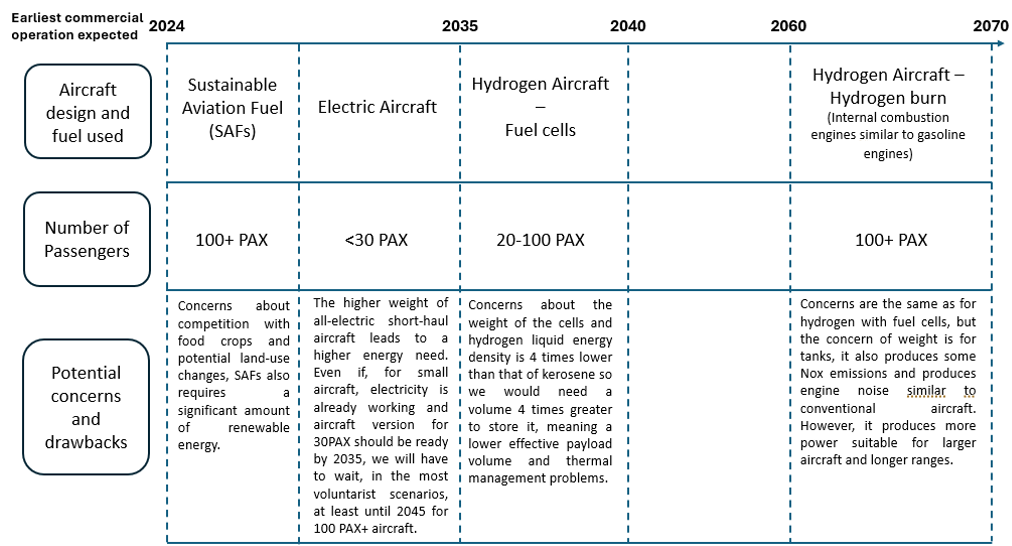
Today, the categories of aircraft currently being designed and the fuel used are covering all currently used aviation’s segments. They address aircraft capability demand from less than 30 PAX to 100+ PAX but also a variety of range from short-haul to long-haul.
As the table above illustrates, these approaches, though crucial, are not without potential drawbacks and may take decades to fully realize their environmental benefits. In the face of urgent climate concerns, the aviation industry cannot afford to wait. This is where immediate, actionable strategies come into play, solutions that can be implemented now to make a tangible impact on reducing the sector’s environmental footprint of aircraft (in flight and on ground) and of infrastructure through electrification and optimization.
Electrification is helping the aviation’s green revolution
We have seen that electrification plays a major role in the aviation industry through its implication in the future propulsion systems, but while much attention has been focused on revolutionary aircraft designs and alternative fuels, the electrification of various aspects of aviation operations is quietly making significant strides in greening the skies.
Electric ground support equipment (eGSE) to power down emissions
Ground support equipment (GSE) is essential for every flight—for baggage carts, fuel trucks, and tugs that keep the airport alive. Traditionally, these vehicles have been powered by diesel, contributing to greenhouse gas emissions and air pollution. Now, eGSE is becoming the industry standard working electric motors. Seattle-Tacoma International Airport reported that the adoption of e-GSE saves roughly 10,000 tons of greenhouse gas (GHGs) per year. Ground support efforts are further complemented by the rise of green taxiing solutions, where aircraft use electric-powered systems to taxi on runways without engaging their jet engines. By integrating both e-GSE and green taxiing technologies, airports can significantly cut their environmental footprint while improving operational efficiency.
Fixed electrical ground power (FEGP) and renewable energy sources to clean power on the ground
Aircraft require power even when parked at the gate, whether it’s to run the lights, air conditioning, or onboard systems. In the past, this power often came from onboard auxiliary power units (APUs), which burn jet fuel and emit carbon dioxide. FEGP systems provides clean, renewable energy directly to the aircraft from the airport’s power grid. Many airports are also turning to renewable energy sources like solar or wind to supply this power, making ground operations life cycle greener.
The aviation industry is developing flight and ground optimizations for a sustainable future
From the moment a flight is planned until it touches down at its destination, there are numerous strategies and technologies working together to reduce the environmental footprint of each journey. Firstly, here is how the industry is optimizing flight operations to move towards a greener future.
By optimizing navigation with ATM, PBN, and contrail avoidance
By using satellites and on-board equipment rather than traditional ground-based beacons, Performance-Based Navigation (PBN) allows aircraft to follow more direct routes. PBN is the aviation equivalent of upgrading from a paper map to a GPS. This precision minimizes fuel consumption by reducing the distance flown, which in turn cuts down on carbon emissions. The PBN concept has been introduced by ICAO in 2008, but it is still in the process of being implemented globally (The European Union’s Regulation 2018/1048 stipulates that most operations should apply PBN by June 6, 2030). IATA estimates that globally, shorter PBN routes could cut CO2 emissions by 13 million tons per year. It’s a win-win for airlines and the environment.
PBN contributes to the precision of modern air traffic management (ATM) systems coupled with flight trajectory and fuel optimization. They also allow aircraft to navigate the most efficient routes in real-time by steering clear of turbulence or taking advantage of tailwinds. In 2024, Airbus and the European ATM Master Plan estimated that optimizing flight trajectories and improving coordination with air traffic management partners can reduce average CO2 emissions per flight by 5-10%. To save energy and therefore reduce emissions some actors, as Airbus UpNext with fello’fly, are also considering flying in formation with a “V-shaped” flight pattern inspired by migrating geese.
ATM systems also rely on contrail avoidance strategy which is mainly to divert the aircraft trajectory and especially the altitude of flights to avoid water vapor. Contrails, which increase the effect of global warming taking into account a concept called “Energy forcing”, may account for more than half (57%) of the entire climate impact of aviation according to the BBC. Let’s note that a study made by the Japanese airspace showed that a minority of flights (2% of the flights) have a significant climate impact (representing 80% of the energy forcing concerning contrails), and that significant gains are conceivable if these aircrafts adapt their trajectory to avoid these zones that are conducive due to the altitude and the weather, by changing flight times and trajectories.
By applying continuous climb operations (CCO) and continuous descent operations (CDO)
When driving a car on a highway, it’s much more fuel-efficient to maintain a steady speed than to constantly brake and accelerate. The same concept applies to airplanes. Continuous Climb Operations (CCO) and Continuous Descent Operations (CDO) ensure that aircraft climb and descend in a smooth, uninterrupted manner, reducing fuel burn and emissions. In 2023, according to NATS achieving just a 5% increase in CDOs across the UK alone would save around 10,000 tons of CO2 per year.
By applying collaborative decision making (CDM)
Sustainability in aviation is a team effort, and Collaborative Decision Making (CDM) is a real collaboration initiative. CDM brings together airlines, airports, and air traffic controllers to share real-time information and make joint decisions that optimize efficiency. Whether it’s adjusting departure times to avoid congestion or coordinating gate assignments to reduce taxi times, CDM ensures that every player is working towards the common goal of reducing environmental impact. CDM can have several positive impacts as improved decision quality, enhanced stakeholder buy-in, increased innovation, better resource allocation, and CDM also plays a significant role in the mitigation of holding patterns, a significant CO2-eq emission source. It is important to note that the direct impact on emissions can be challenging to quantify precisely but CDM has been applied in various environmental contexts with positive results as the improvement of ATM.
By using surface congestion management
Airports can be busy, with aircraft taxiing, taking off, and landing in quick succession. This congestion not only causes delays but also leads to unnecessary fuel burn and emissions as planes wait in line on the tarmac. Surface congestion management systems are the air traffic control of the ground, optimizing the flow of aircraft to minimize delays and reduce fuel consumption. By efficiently coordinating ground movements, SCM also plays a crucial role in preventing aircraft from entering unnecessary airborne holding patterns, or hippodromes, which further increase congestion and fuel burn. In 2012, an article from the MIT estimated the benefits of SCM over only 8 major airports and calculated a total over $2 billion in fuel savings over the next 20 years.
By adopting advanced load management
Where luggage and cargo are placed in an aircraft can make a big difference in fuel efficiency. Advanced load management systems ensure that weight is distributed in a way that minimizes drag and maximizes efficiency. Properly balanced aircraft require less fuel, which means fewer emissions. In 2024, a-ice estimated that optimizing the center of gravity can reduce fuel burn by 1 to 2 % per flight.
By building sustainable airport infrastructure
As airports continue to expand and modernize, there’s a growing emphasis on sustainable infrastructure. Green-certified terminals are leading the way, designed with energy efficiency, water conservation, and sustainable materials in mind. These terminals often feature advanced heating and cooling systems, low-energy lighting, and even green roofs that help insulate the building and manage stormwater. Beyond the terminals, airports are investing in sustainable transport options, like electric shuttles and bike paths, to reduce the environmental impact of passenger journeys. By building a greener ecosystem around and in the airport, it contributes in reducing GHG emissions (through electrification, sustainable energy plants, etc.), in improving water conservation and management (For instance, Sydney Airport’s water-saving initiatives save 75 million liters of water annually), in reducing waste and enhancing recycling, in protecting biodiversity, etc.
The digital transformation of aviation is shaping a sustainable future
As we’ve explored the various initiatives driving aviation’s green revolution, a common thread emerges: the pivotal role of digital technology. From performance-based navigation to advanced load management systems, digitalization is at the heart of many sustainability efforts in the aviation industry. The integration of cutting-edge technologies is not just enhancing operational efficiency but also significantly contributing to reducing the industry’s environmental footprint thanks to groundbreaking innovations as digital twins, AI-powered systems or blockchain structures. However, as we embrace this digital revolution, it’s crucial to recognize both its immense potential and the challenges it presents.
The balance of progress: managing digitalization’s energy demand
While digitalization is key to achieving sustainability in aviation, it also brings challenges, particularly in terms of energy demand. The massive data centers and computing power required to run AI algorithms and digital platforms consume significant amounts of energy. If this energy comes from non-renewable sources, the environmental benefits of digitalization could be offset by increased carbon emissions. This makes it crucial for the aviation industry to power its digital transformation with renewable energy sources. Many airports are investing in solar panels, wind turbines, and other renewable energy sources to ensure that their digital operations are as green as their physical ones. In May 2022, a ISAE-Supaéro report established that the global carbon intensity of electricity worldwide (if not coming from a renewable source) was 132 gCO2-eq/MJ whereas kerosene combustion emits 88 gCO2-eq/MJ. By estimating the 2050 global aviation energy demand, if we don’t change the global energy mix of electricity worldwide the aviation industry will emit 1 GtCO2-eq more than if it would use kerosene. This highlights the importance of the traceability of the energy used and a globalization of sustainable energy produced. Moreover, besides the energy demand problem and the current energy mix impact, another main problem is the one of rare-earth materials (Graphite, cobalt, indium, tungsten…) present in all digital solutions. As the book The war of rare minerals of Guillaume Pitron describes: “Our quest for a new growth model has led to further mining of earth’s crust to extract rare metals, with environmental impacts worse than oil extraction.” If the solution for reducing the environmental impact of aviation passes through the digitalization, the need to find more eco-responsible materials is a priority.
To put the matter in a nutshell, while the aviation industry is making notable progress in reducing its environmental impact through various innovative strategies, it’s important to recognize the potential downsides of these solutions. The shift towards electric and hydrogen-powered aircraft, for instance, holds great promise for zero-emission flying but also poses significant challenges in terms of energy storage and infrastructure. Similarly, the increased reliance on digitalization and AI to optimize flight operations brings the risk of higher energy consumption and GHG emission, especially if not powered by renewable sources. The consequences of the possible negligence regarding the sourcing of the materials and energy used for digitalization could be worse than the actual situation, therefore the traceability of these resources is crucial. Operational strategies that we have seen are already cutting down emissions, but they require precise coordination and could lead to increased complexity in air traffic management.
While these advancements are steering the aviation industry toward a greener future, they also highlight the need for careful consideration and balanced implementation to avoid unintended environmental impacts. This represents a real challenge for aerospace companies. Alcimed helps key actors in taking the right strategic decisions and in supporting them through the evolution of their projects. Don’t hesitate to contact our team.
About the author,
Alexandre, Project Manager in Alcimed’s Aerospace-Defence team in France