Healthcare
Human digital twins for personalized medicine: a new promising technology?
Overview of the concept, usages, and limits of the Digital Twin technology and the new concept of Human Digital Twins.


The concept of Digital Twins has its roots in NASA’s Apollo program, where engineers used mirrored systems on Earth to replicate spacecraft behavior and support mission decisions. While these early models were not digital in today’s sense, they laid the groundwork for what has evolved into the Digital Twin. Today, Digital Twins have become for example a cornerstone of Industry 4.0, transforming industries by integrating IoT, AI, big data, cloud, and edge computing technologies.
The Digital Twin market is projected to grow from $10.3 billion in 2023 to $61.4 billion by 2030, at a CAGR of 34.3%1Grand View Research, 2023 expecting over 75% of industrial IoT implementations to incorporate Digital Twin technology2Gartner, 2023.
In this article, Alcimed explains how digital twins work, explores their potential applications across different sectors, and discusses the challenges that still need to be overcome to enable widespread adoption.
A Digital Twin (DT) is a dynamic virtual representation of a physical object, system, or process, continuously or periodically synchronized through data exchange, in real time or not. This seamless integration enables the twin to reflect, analyze, and influence the physical counterpart’s performance and behavior throughout its lifecycle. Unlike traditional models, Digital Twins allow for bidirectional communication, data from the physical twin updates the digital model, and insights or instructions from the digital model influence the physical system. This modeling approach provides thus accurate description of object that change over time.
Understanding Digital Twins requires recognizing their different levels of integration:
The rise of Digital Twins coincides with the explosion of IoT devices, the high costs of data storage, and advancements in AI-driven predictive analytics. This ecosystem enables organizations to overcome the inefficiencies of siloed data, offering a unified, predictive view of operations. Their purpose is to:
At their core, Digital Twins serve as a living, data-driven model that continuously learns and evolves, making them indispensable for industries aiming to transition into smarter, more connected systems. Digital Twins are no longer confined to manufacturing or aerospace; they are now present in sectors like energy, healthcare, smart cities, retail, and logistics, creating unprecedented opportunities for optimization and innovation.
Digital Twins are unlocking opportunities across industries by enabling real-time decision-making, predictive maintenance, and process optimization. Here are the some transformative use cases:
Smart factories leverage Digital Twins to optimize workflows, reduce downtime, and improve product quality. For example, Unilever uses Digital Twins to model production lines, enabling rapid reconfiguration to meet changing demand patterns, or General Electric (GE) uses Digital Twins for jet engines and gas turbines, where real-time data from sensors continuously update the virtual model, which in turn informs maintenance schedules and operational adjustments—creating a bidirectional data flow that results in an estimated $500 million annual savings through predictive maintenance and improved efficiency.
By harnessing predictive analytics and process automation, organizations can improve their efficiency by 25–30%. Also, Digital Twins can reduce maintenance costs by 20-25% and increase asset uptime by 10-15%1Gartner.
Power grid operators use Digital Twins to model electricity flow, predict failures, and integrate renewable energy sources. Shell employs Digital Twins in offshore rigs to monitor equipment health, where sensor data continuously feed the virtual twin, enabling dynamic adjustments to operations that reduce risks. BP’s Clair Ridge oil platform leverages a Digital Twin to optimize production and reduce downtime, increasing operational efficiency by 15%.
Digital Twins can save up to $50 billion globally in unplanned downtime annually for the oil and gas industry2IoT Analytics, 2023.
Virtual patients (Digital Twins of human physiology) enable precision medicine and accelerated drug development. For instance, Philips’ “Virtual Heart” Digital Twin uses patient data to create a dynamic model that evolves with ongoing medical inputs. While the current usage mainly involves unidirectional data flow (patient to model), emerging applications are exploring feedback loops where treatment outcomes inform iterative updates to the model, enhancing procedure planning and reducing trial-and-error surgeries by 20%. Siemens develops twins of imaging devices to reduce patient wait times and improve diagnostics.
The global market for Digital Twins in healthcare is projected to grow at a CAGR of 25.6%, reaching $8.2 billion by 20303MarketsandMarkets, 2023.
Cities like Singapore use Digital Twins for urban planning, traffic management, and resource optimization. Sensor networks provide real-time data that update the Digital Twin, which can then simulate and recommend adjustments, such as traffic signal timing changes or energy distribution optimization. This bidirectional flow helps predict infrastructure stress points and avoid costly overruns.
Cities can reduce energy consumption by 10-15% using Digital Twins for infrastructure optimization4Smart Cities Council.
Real-time simulation of logistics networks allows companies like DHL to forecast delays and optimize routes dynamically. Digital Twins receive continuous data from vehicles and warehouses and provide actionable insights that lead to adjustments in routing and inventory management, resulting in a 20-25% improvement in delivery efficiency.
Companies using Digital Twins in supply chain management can reduce logistics costs by up to 30%5PwC.
Smart Farming: DTs integrate IoT sensors, drones, and satellite data to optimize irrigation, fertilization, and crop rotation, boosting yields by up to 15%. These models continuously collect data from the field and send control commands back to irrigation systems and autonomous machinery, minimizing downtime and reducing costs through predictive maintenance.
DTs model ecosystems to enhance biodiversity and soil health, promoting sustainable farming practices.
Virtual-Physical Integration: DTs replicate real-world environments for immersive virtual tours, training, and collaborative problem-solving. While largely focused on simulation, some applications incorporate real-time user data to personalize experiences, although bidirectional data exchange with physical counterparts is still emerging.
DTs power VR and AR tools for lifelike simulations in healthcare, aerospace, and more.
While Digital Twins promise significant rewards, they also come with substantial challenges that must be addressed for successful implementation.
The lack of universal standards for data formats, interoperability, and security creates fragmentation in the Digital Twin ecosystem. Over 60% of organizations cite lack of interoperability as a key barrier to Digital Twin adoption6IoT Analytics, 2023. Without standardization, organizations face difficulties integrating systems across vendors or industries.
Efforts by organizations like ISO and industry consortia are paving the way for global interoperability standards. Adopting these will be essential for long-term success. For instance, the Industrial Digital Twin Association (IDTA) is actively developing frameworks to ensure seamless interoperability among different Digital Twin systems.
Digital Twins rely on massive amounts of data, requiring robust storage, computing power, and network bandwidth. For example, a single jet engine Digital Twin generates terabytes of data daily, which can strain existing IT infrastructure. A Digital Twin for a Boeing 787 generates approximately 500 gigabytes of data per flight7Forbes, 2022. The global volume of data generated by Digital Twins is expected to reach 79 zettabytes annually by 20258IDC.
Investments in edge computing and AI-driven data compression techniques can alleviate bottlenecks, ensuring smoother operations. However, deploying a Digital Twin platform for an enterprise can range from $200,000 to over $1 million, depending on the complexity and scale9McKinsey, 2023.
As Digital Twins are connected systems, they are vulnerable to cyberattacks targeting sensitive operational data or physical systems. In 2021, a simulated attack on a Digital Twin platform showed that a malicious actor could manipulate system data to cause real-world equipment failures. The average cost of a data breach involving IoT systems is $4.24 million10IBM, 2023.
Implementing end-to-end encryption, real-time monitoring, and AI-driven threat detection is vital for secure deployment.
The energy demands of Digital Twins, particularly in cloud-heavy deployments, raise sustainability concerns.
Leveraging renewable-powered data centers and optimizing models to use minimal computing resources can mitigate these challenges. Moreover, promoting a “right use” approach, where Digital Twins are deployed only when their benefits clearly outweigh their environmental and operational costs, ensures that their adoption remains both efficient and responsible.
The skills required to design, implement, and maintain Digital Twins—such as AI, IoT, and systems integration—are scarce.
Upskilling initiatives and partnerships with academic institutions can help bridge this gap over time.
Learn more about how our team can support you in your projects related to digital twins >
Digital Twins represent a profound transformation in how organizations design, operate, and optimize systems.
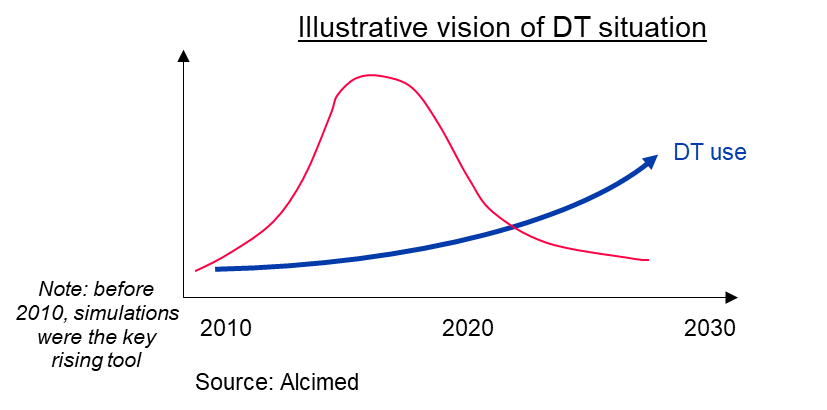
Yet, despite being discussed for over a decade, the concept has sometimes been perceived as overhyped or slow to deliver on its promises, with many initiatives stalling at the pilot stage. This gap between expectations and large-scale deployment has often been due to technical complexity, unclear ROI, or fragmented ecosystems.
However, the market is now entering a phase of real acceleration, driven by the convergence of mature enabling technologies (IoT, AI, edge/cloud computing), falling costs, and the growing need for operational resilience and sustainability. What was once a theoretical concept is increasingly becoming a strategic asset adopted at scale.
To maximize their potential, stakeholders must:
Organizations that can navigate these challenges will unlock unprecedented efficiencies, innovation, and resilience. Digital Twins are not just a technological trend, they are the blueprint for the future of interconnected industries.
Digital Twins are revolutionizing industries by creating real-time, predictive, and data-driven models of physical systems and are no longer a futuristic concept. As the technology continues to mature, its applications will expand across various sectors, offering opportunities for both large enterprises and small businesses alike. The key to successful adoption lies in overcoming the challenges of data integration, cybersecurity, infrastructure demands, and talent shortages.
Organizations that adopt Digital Twin technology early and strategically will position themselves to lead in innovation, operational efficiency, and customer satisfaction, ensuring their competitive advantage in the years to come.
At Alcimed, we support our clients in making Digital Twins a true lever for transformation, from identifying the most relevant use cases and collecting operational feedback (RETEX), to evaluating performance and supporting change management through internal evangelization strategies. Our cross-sector expertise and ability to translate innovation into actionable roadmaps make us a trusted partner for deploying Digital Twins effectively and sustainably. Don’t hesitate to contact our team.
About the author,
Alexandre, Consultant in Alcimed’s Aerospace Defense team in France
Healthcare
Overview of the concept, usages, and limits of the Digital Twin technology and the new concept of Human Digital Twins.

Healthcare
Approach n°1: Using innovative technologies for in-vitro assays In the present advancing era of technologies, alternative methods for animal studies are being developed through innovative ...

Cosmetics
Trend n°1: personalized beauty Personalized beauty is a trend making a strong come back with firstly the emergence of diagnostic tools to have adapted recommendations and then, the development of ...