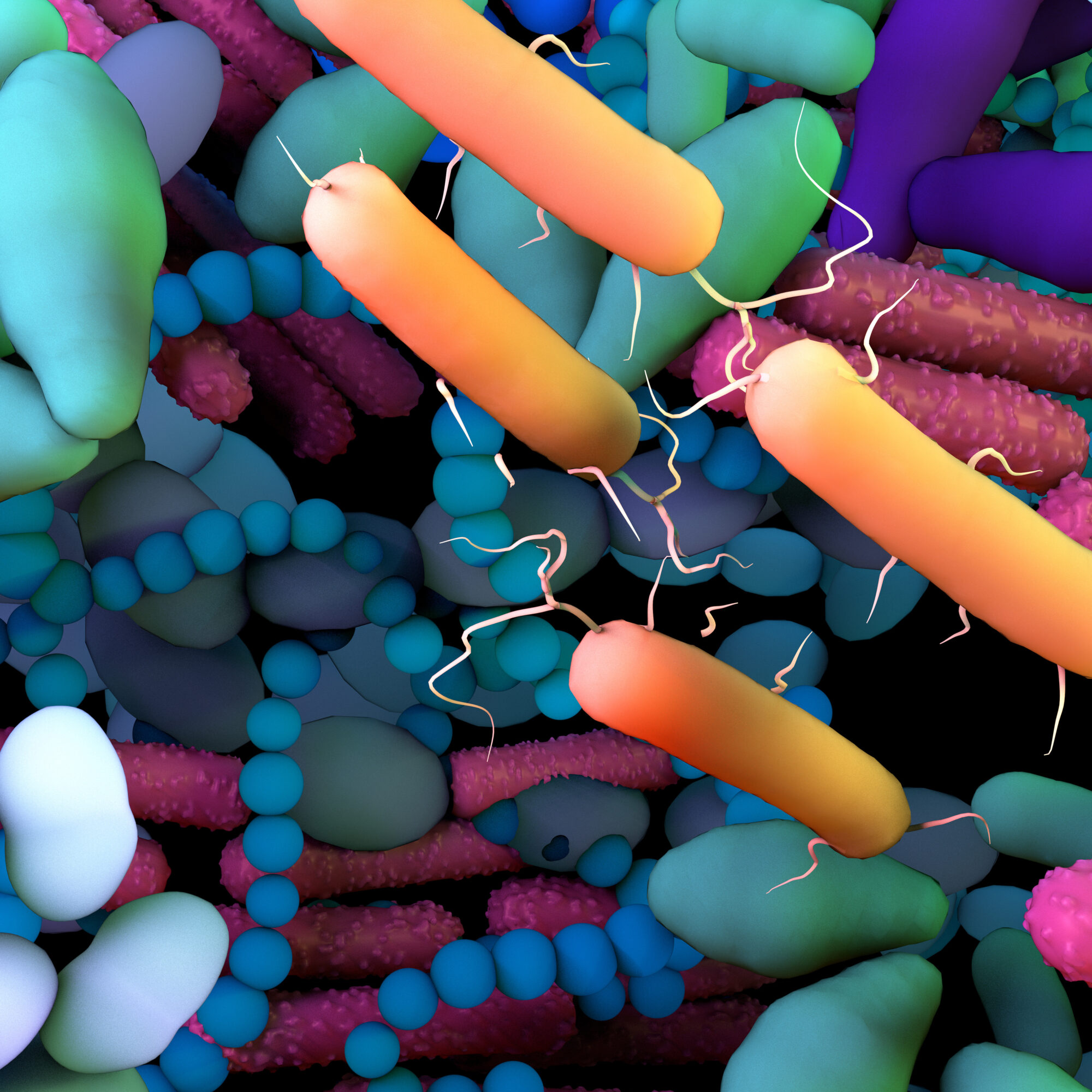
Microbiome: a key player in human health and vaccine response
Bidirectional interactions between host health and microbiome status
On the one hand, the microbiome has an impact on host health. Dysbiosis, defined as an imbalance in the microbiome, can lead to inflammation. The microbiome is therefore involved in chronic inflammatory diseases, metabolic disorders, and infectious diseases. It also plays a role in mental health, healthy aging, and women’s health.
On the other hand, the host’s health status influences the microbiome, and many conditions, whether infectious, inflammatory, or autoimmune (obesity, inflammatory bowel diseases, diabetes, etc.), can lead to dysbiosis.
Read also: How can gut microbiome play a role in improving women’s health?
The role of the microbiome in immunity and vaccine response
Immune responses induced by vaccines show significant inter- and intra-individual variability. This is partly explained by factors such as age, genetics, or prior exposure to the pathogen. The microbiome, which plays a key role in the development and regulation of the host immune system, can also influence vaccine efficacy and immunogenicity, meaning the ability to trigger a specific immune response. This influence can be either beneficial or detrimental, depending on the type of microorganisms and, in the case of bacteria, their family, genus, or species.
Microbial signatures: predictive biomarkers of vaccine response
In addition to influencing immune responses, the state of the microbiome could help predict an individual’s response to a vaccine. Many studies have concluded that higher abundance of Bifidobacterium and low presence of Gammaproteobacteria are associated with stronger vaccine immunogenicity. These observations have been documented for vaccines against influenza, hepatitis B, SARS-CoV-2, rotavirus, and others.
Thus, vaccine response could be differentiated and predicted based on specific microbial signatures, opening new avenues for vaccine innovation.
Microbiome and perspectives for vaccine innovation: combined and targeted biotherapeutic strategies
Modulating vaccine efficacy through adjuvant biotherapies
Strategies are being explored to optimize vaccine responses through co-therapies with “biotics,” including probiotics, prebiotics, and postbiotics. The first refers to live microorganisms beneficial to health, while the latter two refer to molecules with beneficial health effects. These approaches are being used as pre-adjuvants, administered prior to vaccination to achieve immune conditioning.
In the case of influenza vaccines, researchers have shown that supplementation with Bifidobacterium may improve vaccine efficacy. Similarly, increased levels of Bifidobacterium and Lactobacillus following the administration of certain prebiotics have been associated with stronger vaccine responses in several clinical and preclinical studies, particularly in infants.
This immune modulation prior to vaccination is particularly relevant for specific populations that often show suboptimal vaccine responses, such as infants with early antibiotic exposure, elderly individuals, immunocompromised patients, or those with comorbidities.
In addition, as in many therapeutic areas, vaccine innovation is increasingly moving toward personalization. Individual microbiome sequencing opens the door to promising therapeutic strategies aimed at improving vaccine efficacy through targeted biotic adjuvants. The biopharmaceutical company Microbiotica, for example, is developing specific microbial communities (bacterial consortia), currently being explored in oncology and inflammatory bowel diseases. This metagenomic platform, focused on studying the genome of microorganisms present in an environment, could enable the development of immunomodulatory bacterial consortia with potential use as vaccine adjuvants.
Learn more about how we can support your microbiome-related projects >
Targeted microbiome therapies: applications across multiple therapeutic areas
Beyond its role as a vaccine adjuvant, the microbiome can also be a direct therapeutic target, particularly in the treatment of inflammatory diseases. In this approach, the vaccine targets not only a pathogen but also a specific microbial population.
Research has been conducted, for instance, on developing a vaccine targeting harmful bacterial populations that are overrepresented in inflammatory contexts, through the production of anti-flagellin antibodies that reduce their proliferation and consequently inflammation.
In oncology, for example, a bacterial nano-vaccine has been developed with a biomimetic action. Belonging to the class of therapeutic vaccines, its mechanism differs from peptide-based, viral vector-based, or dendritic cell-based vaccines. In addition to enhancing the immune activity of antigen-presenting cells, its bacterial adjuvants also target and eliminate harmful microorganisms in colorectal cancer associated with the bacterium F. nucleatum. By preserving the healthy microbiome, this emerging therapy may improve the efficacy of chemotherapy.
Other microbiome-derived biotherapies in phase I and II clinical trials are being studied in combination with immunotherapies in glioblastoma (brain tumor) and adrenal tumors.
The microbiome as a key component in the development of vaccine biotherapies
The microbiome can act as a valuable therapeutic biobank. Indeed, an innovative vaccine has been developed from the skin microbiome, specifically from the commensal bacterium S. epidermidis. Administered topically, this treatment triggers an immune response in animal models. It could help prevent diphtheria and tetanus infections, and its use may be extended to other infectious diseases (National Institute of Allergy and Infectious Diseases, Stanford).
Scientific and regulatory challenges to overcome for biotherapy development
Innovating with living systems: technical constraints
Although microbial signatures have been associated with certain vaccine responses in animal models or small clinical cohorts, identifying universal predictive signatures remains a challenge. Developing these living biotherapies requires the standardization of bacterial consortia with consistent individual efficacy.
Several constraints must also be addressed. First, microbial stability must be ensured, meaning their ability to maintain consistent characteristics over time and under different culture and storage conditions. Second, reproducibility across batches and production runs must be guaranteed, with bacterial consortia delivering comparable composition and functionality. These aspects must be demonstrated in compliance with Good Manufacturing Practices (GMP) and validated through stability studies. These stringent requirements are essential to ensure the reliability of biological products intended for commercialization.
Furthermore, studies linking microbiome and vaccination share certain limitations, including:
- They still rely significantly on preclinical studies or small clinical cohorts;
- They often report correlations rather than causal relationships.
To establish robust causal links between the microbiome and vaccine response, it is essential to strengthen research efforts, particularly by standardizing inclusion criteria, bacterial strains, and metagenomic analyses.
Read also: The 4 key roles of microbiota in the gut-brain axis: focus on Alzheimer’s disease
An evolving regulatory framework
Microbiome-based vaccine innovations and microbiome-derived biotherapies lie at the interface between vaccines and broader categories of biological products. This can complicate their classification and lead to differing safety, health, and regulatory requirements.
In summary, recent years of research confirm the bidirectional relationship between human health and the microbiome. The microbiome is emerging as a key player in the immune response, capable of modulating vaccine efficacy. It appears both as a predictive biomarker of vaccine effectiveness and as a therapeutic target to optimize responses or develop innovative immunotherapies across multiple therapeutic areas.
In the dynamic vaccine sector, new avenues are emerging:
- Modulating vaccine efficacy with pre-adjuvant biotics and personalized bacterial consortia,
- Developing new vaccines derived from commensal microorganisms, for example,
- Designing vaccines targeting or derived from the microbiome to develop new biotherapies against various diseases.
Despite ongoing scientific, technological, and regulatory challenges, these innovations pave the way for more effective and personalized vaccination strategies, as well as the development of innovative targeted biotherapies.
Interested in these perspectives or exploring new microbiome-related therapies? Alcimed is here to support you in navigating these rapidly evolving fields. Do not hesitate to contact our team!
About the author,
Clémentine, Consultant in Alcimed’s Healthcare team in France