The rising demand for innovation in neurological rehabilitation
Limited functional recovery in many neurological indications
Globally, an estimated 2.41 billion people could benefit from rehabilitation at some point in their lives.
The recovery rates for brain injury after 5 years from diagnosis are: 26% improved, 22% did not change their condition, 30% worsened, 22% died, while stroke survivor patients: 10% recover almost completely while an additional 25% have minor impairments, 40% require special care and 10% require care from facilities like nursing homes.
These numbers highlight the pressing need for accessible and effective rehabilitation programs.
Rehabilitation process should start as soon as possible and the duration may vary based on the patient and the condition. Ideally the patients would start rehabilitation in the hospital setting, and then after they reach stability, they can be transferred to rehabilitation units (if available), in an in-patient setting, or receive rehabilitation through clinics in an out-patient setting.
Structural constraints in existing neurological rehabilitation programs
Conventional rehabilitation strategies use exercises to improve the motor skills needed to perform daily activities. A physical or occupational therapist will supervise and guide rehabilitative practices, implementing repetitive task training to reformulate neuromotor connections and to increase strength, range of motion, and coordination.
However, conventional rehabilitation faces many challenges, mainly tied to hospital organization and patient participation for example:
- Healthcare systems experience resource limitations and often prioritize costs over patient-centered care. This can lead to delays in accessing the necessary therapies and standardized treatment that fail to meet patient-specific needs, overall impacting recovery outcomes.
- Patient participation is key for success, however conventional rehabilitation can be frustrating for patients, and integrating their perspective can be challenging.
Virtual reality in neurological rehabilitation: insights from recent studies
Virtual reality emerged in the 1960s and was first introduced in the healthcare field in the 80s for medical training and simulation exercises, for example medical students and surgeons could practice complex procedure through virtual reality.
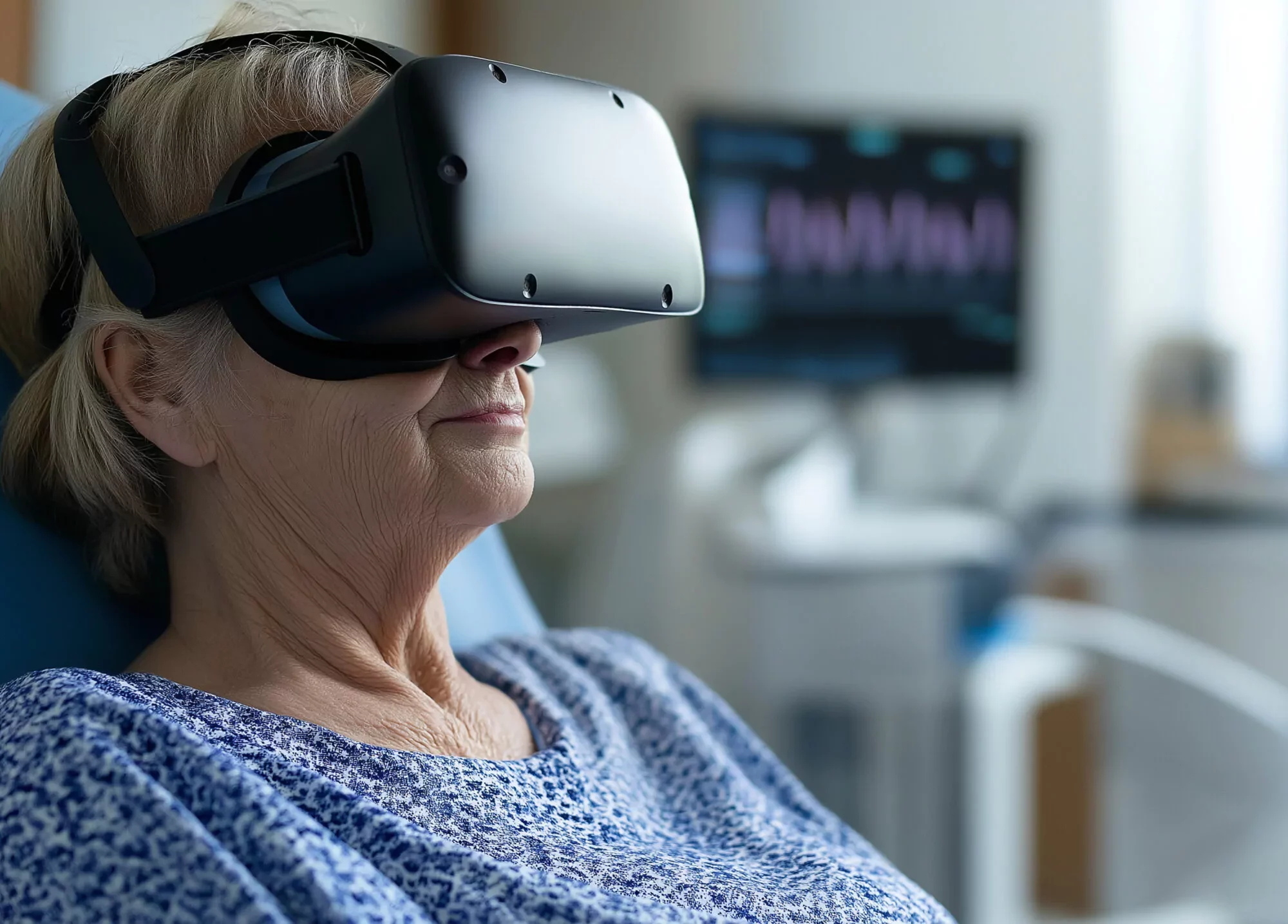
Virtual reality allows the users to immerse themselves in a computer generated environment that simulates reality, can transform and improve current neurological rehabilitation processes.
Rehabilitation tasks performed through virtual reality can be customized and gamified, incentivizing patient motivation and participation; whereas conventional rehabilitation is repetitive, which can lead to fatigue, monotony and low motivation.
Indeed, recent studies have integrated virtual reality for acute neurological rehabilitation to conventional rehabilitation to improve or recover motor function, cognitive abilities, speech and communication for patients recovering from nervous system injuries or disorders (e.g. stroke, brain and spinal cord injuries, multiple sclerosis and others).
For acute neurosurgery and neurotrauma patients
A single group, clinical feasibility study was designed in a neurosurgical center, with the aim to investigate the feasibility and initial clinical safety of using VR in the neurorehabilitation process for acute neurosurgery and neurotrauma patients. The VR intervention used was composed by hardware in the form of headphones and controller and software from SyncVR Medical (Amersfoort, The Netherlands).
The technology was used by neurorehabilitation experts after stroke and spinal cord injury for both physical and cognitive recovery, combined to conventional rehabilitation.
The study demonstrated that VR neurorehabilitation is feasible, safe and acceptable to deliver with high fidelity and observed minimal and tolerable side effects, mainly blurred vision. This supports the integration of VR in acute neurosurgical rehabilitation setting, potentially accelerating recovering and maintaining cost-effectiveness. Further studies are necessary to explore and optimize the split between human and VR therapy, as well as to evaluate economic implications.
For stroke patients
A randomized controlled trial was designed to evaluate effectiveness, safety and perception of a VR-based physical rehabilitation for stroke patients to improve upper limb motor function. The technology used was composed by a head mounted display (HDM) and controller as hardware, and the software was developed with Unity Technologies, USA and Votanic Ltd., China.
In this study the immersive virtual reality approach was combined with conventional physical therapy, on patients with acute post-stroke hemiparesis. It showed a significantly higher recovery of the upper limb motor function in the VR group compared to the control group (only conventional physical therapy).
Moreover, patients showed high level of engagement and motivation, and reported no serious adverse events.
In these studies the integration of VR neurological rehabilitation with conventional rehabilitation demonstrated feasibility, safety and improvement in function recovery.
Discover our consulting services in the medical device industry >
Key challenges ahead
Despite the promising findings, virtual reality in neurological rehabilitation still faces several challenges before it can be widely adopted and fully deliver its potential.
- Accessibility and cost
High-quality VR systems require advanced hardware (headsets, motion sensors, haptic devices) and specialized software, which can be expensive for healthcare providers and rehabilitation centers to acquire and maintain. While prices are slowly decreasing, affordability remains a barrier, particularly in low-resource settings where rehabilitation needs are often greatest.
- Lack of standardized protocols
Current studies vary significantly in terms of intervention design, therapy duration, and patient selection criteria, making it difficult to compare outcomes or establish clear clinical guidelines for VR rehabilitation.
- Integration in the healthcare systems
To incorporate VR into conventional practice, all HCPs involved require adequate training, and there are concerns about over-reliance on technology at the expense of human supervision, that will need to be overcome.
To reach its full potential and becoming a standard of care, there are several steps required:
- Cost-reduction strategies such as low-cost VR headsets, open-source platforms, and scalable software solutions are necessary to broaden accessibility.
- Long-term randomized controlled trials with larger and more diverse populations should be conducted to establish clinical effectiveness across different neurological conditions.
- Interdisciplinary collaboration between engineers, clinicians, and policymakers should ensure that VR tools are not only technologically advanced but also user-friendly, evidence-based, and compatible with existing healthcare infrastructures, in order to be integrated
Virtual reality offers a powerful and innovative tool to complement traditional neurological rehabilitation, providing immersive, personalized, and motivating environments for patients. Current research demonstrates feasibility, safety, and early signs of effectiveness, yet challenges remain in terms of cost, accessibility, standardization, and integration into healthcare systems.
Future efforts must focus on expanding clinical evidence, lowering barriers to adoption, and designing adaptive, patient-centered solutions. If these steps are achieved, VR has the potential to become a standard component of neurorehabilitation, bridging gaps in care and significantly improving outcomes for individuals recovering from neurological injuries and disorders.
At Alcimed, we keep exploring the field of neurological injuries and disorders to identify innovative and affordable solutions for all patients. Do not hesitate to contact our team!
About the author,
Hélène, Director of Alcimed’s Life Sciences team in Italy
Annelisa, Consultant in Alcimed’s Life Sciences team in Italy