The emergence of emotional durability
It is within this context that a new approach is emerging: emotional durability.
Beyond physical robustness, emotional durability refers to a product’s ability to create and sustain a lasting emotional connection with its user, encouraging them to keep it for longer. First introduced in 2005 by Jonathan Chapman in Emotionally Durable Design and further developed by researchers such as Kate Fletcher, Tara Baeverstock, and Tim Cooper, the concept has gained significant momentum in academic research since 2015. Unlike physical durability, which measures strength and resistance, emotional durability focuses on the symbolic and narrative relationship an object creates: the story it tells, the experiences it evokes, and the emotions it generates.
An increasing number of researchers now view this approach as a key pathway to reducing the environmental impact of the textile industry. It directly challenges industrial and commercial strategies:
- How can clothing be designed to foster long lasting emotional attachment?
- How can this dimension be integrated into public policies and environmental standards?
A new international paradigm transforming the textile industry
At both the French and European levels, several initiatives and research projects are currently underway to integrate this concept into public policies and emerging standards, particularly through the Product Environmental Footprint Category Rules (PEFCR), environmental labeling for textile products, and proposed legislation targeting fast fashion. In 2024, the French Federation for Circular Fashion (Fédération de la Mode Circulaire), a professional association, together with En Mode Climat, a non-profit organization, and COSE361, a sustainability consulting firm launched the first collective European scientific study dedicated to the emotional durability of clothing.
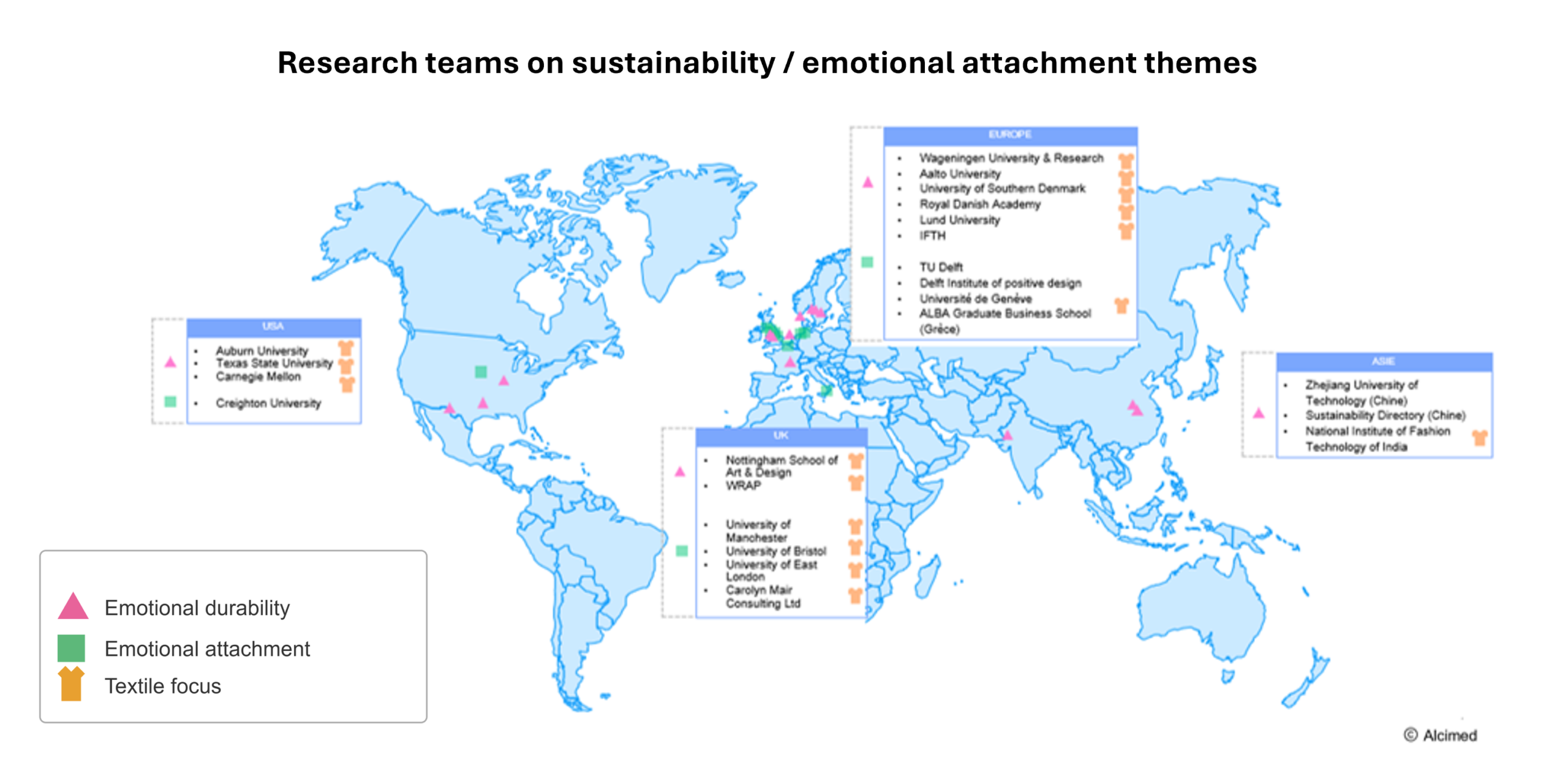
However, this reflection extends far beyond Europe. Emotional durability and emotional attachment are attracting global interest, from the United States (Auburn University, Carnegie Mellon University, Texas State University) to Asia (Zhejiang University of Technology, National Institute of Fashion Technology of India), as well as the United Kingdom (Nottingham School of Art & Design, WRAP, University of Manchester) and continental Europe (Wageningen University, Aalto University, Delft University of Technology (TU Delft), and the University of Geneva). These academic hubs, often closely connected to the textile industry, form a dynamic network that is driving research forward and accelerating the adoption of the concept. This growing international momentum confirms that emotional durability is not simply a passing trend, but rather a new global paradigm for rethinking the relationship between clothing, consumers, and the environment.
Despite this scientific momentum, there is still no consensus or clearly defined framework for translating emotional durability into operational criteria. To move forward, it is essential to connect this research with evolving industrial and commercial strategies in order to make emotional durability a true lever for transforming the fashion industry of tomorrow. Fast fashion did not emerge by chance: it is the result of decades of transformation, from the rise of mass production in the 1960s to today’s ultra responsive business models.
In the first part of this article, discover the key developments in industrial and commercial strategies that have shaped our relationship with clothing and paved the way for the rise of fast fashion.
Alcimed can support you in transforming your industry and addressing the new challenges facing the textile market. Feel free to contact our team.
About the authors,
Vincent, Director of Alcimed’s Chemicals and Materials Business Unit in France
Manon, Consultant in Alcimed’s Chemicals and Materials Business Unit in France